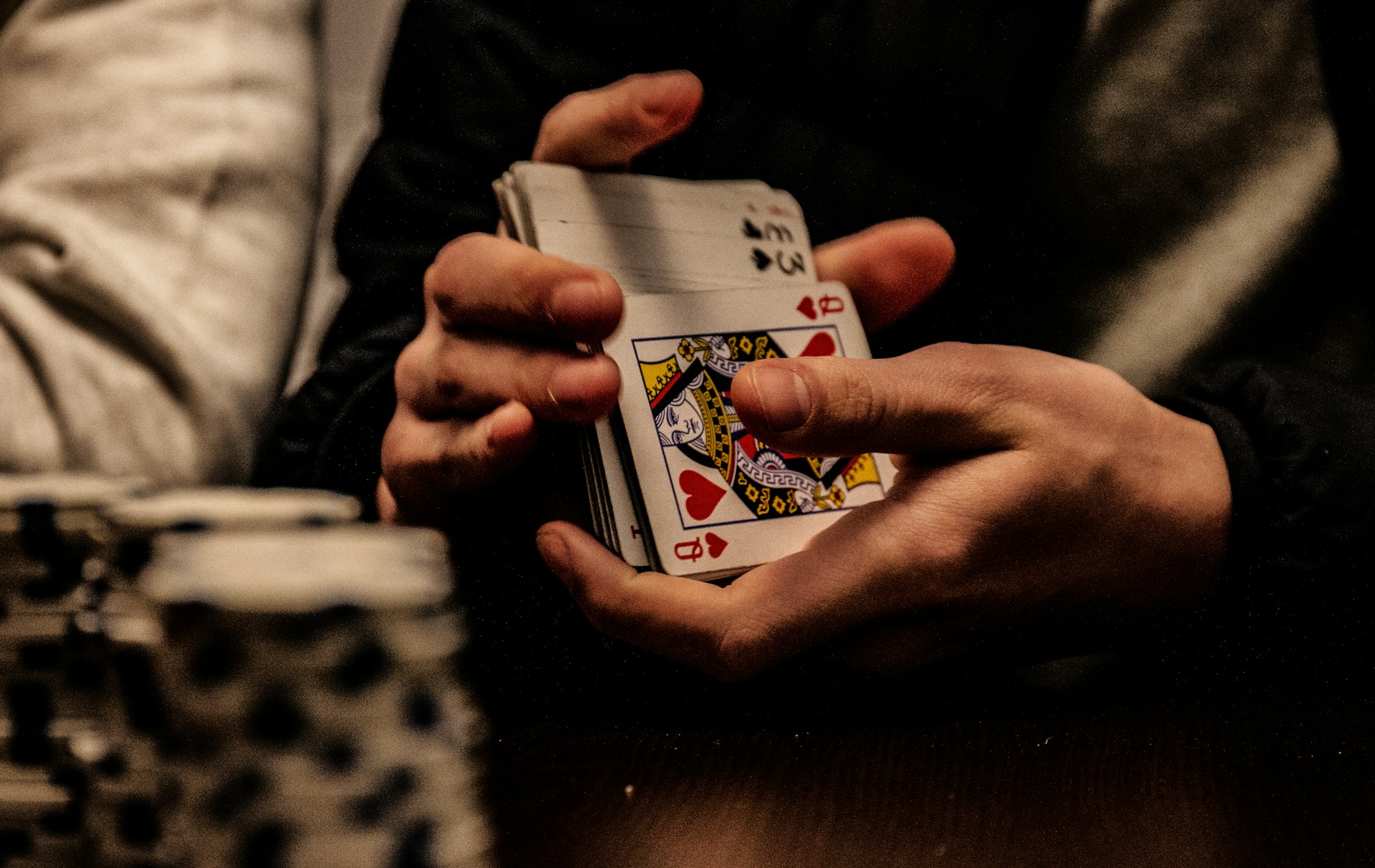

The first card game arrived without instructions. That is, if you were a European merchant in the fourteenth century encountering a Mamluk deck — its suits of cups, coins, swords, and polo sticks travelling overland from the Arab world — the rules were yours to negotiate. Cards were objects before they were systems. They accumulated meaning the way old towns accumulate architecture: one era’s logic laid atop another’s, until the structure itself becomes the history.
It took Edmond Hoyle to impose order. His 1742 treatise A Short Treatise on the Game of Whist was, on its surface, a practical manual — a set of protocols for a fashionable parlour game. But something more significant was happening. Hoyle was codifying behaviour, which is another way of saying he was codifying culture. The phrase according to Hoyle — meaning correct, authoritative, done by the book — entered the language and stayed. He had not merely written rules. He had established the idea that card games were serious enough to require them.
From Hoyle, the lineage moves through the great gambling salons of eighteenth and nineteenth-century Europe: Baden-Baden, Monte Carlo, the private clubs of Pall Mall. These were not merely places to lose money. They were stages — theatrical, architectural, laden with protocol. The baize table, the unhurried shuffle, the silence before the deal: all of it was choreography. Casinos understood, long before Hollywood did, that the drama of chance required a setting worthy of it. The mise-en-scène was part of the wager.
Cinema eventually caught up. Think of the casino sequences that lodge in the memory not because of the gambling, precisely, but because of what the gambling makes visible — status, desperation, composure, desire. The wheel in Casablanca. The baccarat tables of early Bond films, where the game functions as a kind of formalised combat, a duel conducted in silence and evening dress. The sweat-drenched poker rooms of later American cinema, where the myth shifts from European elegance to something rawer and more democratic. Each era’s card table reflects its own anxieties back at it.
Literature ran a parallel track. Dostoyevsky’s The Gambler is less a novel about roulette than a novel about the psychology of repetition — the way a game can become a grammar, a private language, an excuse to keep returning to the same sentence. Stefan Zweig’s chess novellas examine how a game of pure logic can, under the right pressure, become a vehicle for psychological disintegration. The game, in both cases, is a lens. It is not the subject. It is the instrument through which the subject becomes visible. There is something in this worth following — the same way one might follow an unexpected line of inquiry about how physical spaces shape thought, as explored in What If We Discovered Time Moves Differently in Libraries.
This is worth holding onto as we consider where card culture has travelled in the early twenty-first century. The live-dealer studio — that curious hybrid space where physical card-handling is filmed and streamed to players online — might seem, at first glance, like a purely technological development. But look closer. The cameras are positioned to recreate the sightlines of a table. The dealers are trained in the rituals of the game. The felt, the chips, the pause before the flip: all of it is preserved, transmitted, maintained. What survives the digital translation is not the mechanics but the ceremony. The lineage holds. That something so steeped in physical ritual could migrate so completely into digital infrastructure raises questions not unlike those posed by What If the Internet Reset Every Year? — about what we assume will simply persist, and what quietly requires tending.
What has changed, and changed meaningfully, is the framework of accountability surrounding that ceremony. The regulated online casino — operating under provincial licensing, subject to independent auditing, aligned with harm-reduction frameworks — represents a structural maturity that the Monte Carlo salon never had to imagine. Responsible play tools, deposit limits, self-exclusion registers: these are not decorative additions. They are, in their own way, a continuation of Hoyle’s impulse — the belief that games of chance benefit from rules, that pleasure is better when the terms are legible. Organisations like the Responsible Gambling Council exist precisely in that tradition: not to prohibit the game, but to ensure the conditions around it remain humane.
For those curious about how this regulatory landscape actually functions in Canada — which operators hold legitimate licensing, what protections are in place, and what the current standard of compliance looks like — that information is covered here, where vetted publisher coverage of regulated online operators is maintained and updated for Canadian readers.
The cultural history of card games is, ultimately, a history of how societies negotiate with uncertainty. We build tables around it. We write rules for it. We film it, narrate it, licence it, stream it. The cards keep moving. The ceremony, somehow, persists.